

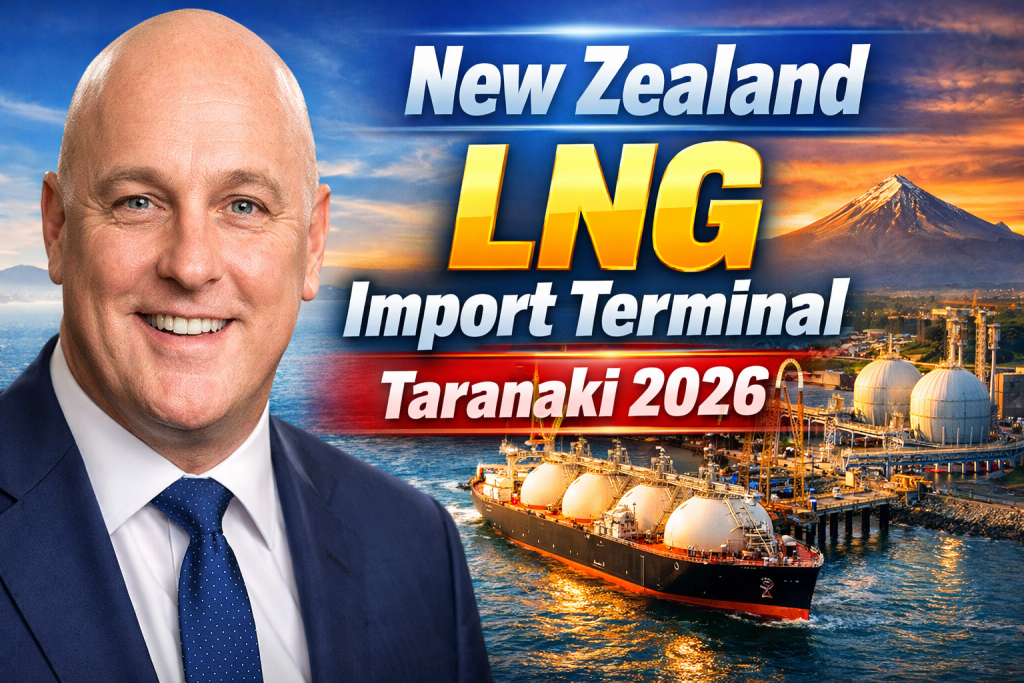
New Zealand’s push for energy security takes a bold step with the Taranaki LNG import terminal project, announced in early 2026. This facility aims to provide a reliable backup fuel source amid declining domestic gas supplies and volatile hydro-dependent electricity generation.
Project Overview
The government selected Taranaki on the North Island as the site for New Zealand’s first liquefied natural gas import terminal. Energy Minister Simon Watts confirmed the decision follows a rigorous procurement process, shortlisting leading proposals for commercial contracting. The terminal will receive LNG shipments from international carriers, regasify the fuel, and pipe it into the existing national gas network.
Taranaki’s selection leverages its established energy infrastructure, including Port Taranaki’s deep-water berths, pipelines, and skilled workforce. The project addresses a critical gap: New Zealand’s gas fields, like Pohokura and Kupe, face depletion by the late 2020s, risking shortages during dry years when hydro lakes run low. LNG imports will act as a flexible bridge, activated only during peak demand to avoid over-reliance.
Proponents highlight its role in stabilizing electricity prices, with estimates of annual savings up to $265 million for consumers by curbing spikes. The facility’s modular design allows scalability, starting with peak shaving before potential expansion.
Detailed Project Specifications
The terminal will feature a floating storage and regasification unit or land-based equivalent, with capacity for large-scale imports—potentially millions of cubic meters daily. Key components include LNG carrier unloading arms, vaporizers, storage tanks holding thousands of cubic meters, and metering stations feeding into Maui and other pipelines.
Safety protocols mirror global standards: double-walled tanks, leak detection, and emergency shutdown systems. Environmental safeguards include vapor recovery to minimize flaring and marine impact assessments for shipping routes.
Port Taranaki positions itself as the hub, offering wharves rated for heavy loads, existing energy services, and proximity to gas processing plants. While exact footprint awaits final bids, concepts draw from smaller Asian terminals, adapted for Taranaki’s seismic zone with reinforced structures.
| Component | Description | Capacity Estimate |
|---|---|---|
| LNG Unloading Arms | Offshore or onshore berths | 10,000-20,000 m³/hour |
| Storage Tanks | Cryogenic, insulated | 100,000-200,000 m³ total |
| Regasification Units | Seawater or air-heated vaporizers | 5-10 MMscf/day peak |
| Pipeline Integration | Tie-ins to Maui, Kupe lines | 200-500 TJ/day |
| Power Supply | Grid-connected with backups | 20-50 MW operational |
This table outlines core elements based on government outlines and Port Taranaki capabilities.
Development Timeline
Planning and Procurement
MBIE launched the registration of interest in October 2025, evaluating sites like Taranaki, Northport, and Southport. By February 2026, Taranaki emerged victorious after stage-one shortlisting. Cabinet approved progression, bypassing further reviews.
Commercial negotiations target mid-2026 contract awards, with preferred developers handling design, build, finance, operate, and transfer models.
Construction Phase
Site preparation begins late 2026, with piling and berthing works through 2027. Modular components—prefabricated overseas—arrive by sea, slashing on-site time. Full commissioning eyes winter 2027 for trial cargoes, operational readiness by early 2028.
Energy Minister Watts emphasized speed: “Definitive decision made—no going back.” Contingencies account for consents, with fast-track legislation if needed.
Long-Term Operations
Initial 15-year contracts extendable, with government buy-back options. First imports likely from Australia, Qatar, or U.S. Gulf—spot or long-term charters. Peak usage: dry-year winters, supporting 10-15% of gas demand.
| Phase | Timeline | Milestones |
|---|---|---|
| Procurement | Feb-Jun 2026 | Shortlist, contract signing |
| Consents & Design | Jul-Dec 2026 | RMA approvals, FEED completion |
| Construction | 2027 | Berth works, tank erection |
| Commissioning | Late 2027-Early 2028 | First LNG cargo, grid integration |
| Full Operations | 2028+ | Annual reviews, expansions |
Phased approach minimizes disruptions.
Economic Impacts
Job Creation and Regional Boost
Taranaki gains hundreds of construction roles—engineers, welders, marine specialists—peaking at 300-500 workers. Operational phase sustains 50-100 skilled positions, reinforcing the region’s energy legacy as Maui field’s successor.
Port Taranaki CEO Simon Craddock called it a “confidence boost,” future-proofing wharves amid shipping declines. Spillover effects: supplier contracts for steel, valves, and services, injecting tens of millions locally.
Nationally, $725 million (NZD 1.2 billion by 2035) in value through price stability. GasNZ supports, projecting lower electricity costs during shortages.
Energy Market Stability
Hydro dominates at 57% of 10 GW capacity; gas-fired plants cover dry-year deficits. Without imports, 2025-2030 forecasts blackouts and $500 million spikes. LNG caps this, enabling renewables ramp-up without reliability gaps.
Businesses like Methanex and dairy processors benefit from steady supply, avoiding curtailments.
| Economic Metric | Projected Benefit |
|---|---|
| Annual Savings | $265 million (consumer electricity) |
| Jobs Created | 300-500 construction; 50-100 ops |
| Regional GDP Lift | 1-2% Taranaki growth |
| National Value (2035) | NZD 1.2 billion |
Quantified gains underscore viability.
Environmental and Social Considerations
Emissions and Sustainability
Critics, including Parliamentary Commissioner Simon Upton, warn of “path dependence” locking in fossils past 2030. Government counters: LNG displaces coal, cuts 1-2 million tonnes CO2 yearly versus alternatives. Peaking role aligns with net-zero—used sparingly.
Mitigation: electrification incentives continue; battery storage complements. Marine impacts assessed via iwi consultations—Ngāti Ruanui and Te Atiawa engaged early.
Community Engagement
Port Taranaki pledges transparency: public forums, traffic studies for LNG tanker calls (4-10/year). Safety zones calm fears of vapor clouds, citing global incident-free records.
Iwi views mixed—economic wins versus emissions concerns. Funding for hapū projects sweetens deals.
Strategic Rationale
New Zealand’s gas production halves by 2030; imports inevitable per MED models. Taranaki edges rivals via infrastructure—no greenfield costs. Alternatives like North Island FSRUs deemed riskier.
Global LNG glut (U.S. exports booming) ensures cheap supply. Geopolitics: diversifies from Australian pipelines amid their decline.
Challenges and Risks
Procurement snags: bidder withdrawals if terms uncompetitive. Consents: Resource Management Act appeals possible, though fast-tracked. Construction: seismic retrofits add 10-15% costs.
Budget: “North of a billion dollars” per Watts—public-private funding unclear. Delays push to 2029 worst-case.
Opposition: Greens decry fossil lock-in; Upton urges renewables pivot.
Stakeholder Perspectives
Energy Minister Watts: “Greater security and peace of mind—definitive action.”
Port Taranaki Chair Jeff Kendrew: “Bolsters region as energy heart.”
GasNZ: “Essential for baseload backup.”
Commissioner Upton: “Risks self-reinforcing fossil path.”
Future Expansions and Alternatives
Scalability: Add tanks for baseload by 2035. Hydrogen blending pilots possible. Rivals: If Taranaki falters, Marsden Point revives.
Integration: Pairs with Tiwai smelter retention, data centers eyeing gas.
Implications for New Zealand’s Energy Transition
Taranaki LNG bridges to 2040—buys time for wind, geothermal, green hydrogen. Ensures lights stay on during transitions, averting 2027-2028 crises modeled at $2 billion GDP hit.
Critics push batteries ($5 billion national pack), but LNG cheaper short-term ($1 billion). Hybrid future likely.
Project cements Taranaki’s energy stature, blending fossil pragmatism with green ambitions. As contracts ink, New Zealand eyes stable winters ahead.

Emma Brooks is a contributing writer at richlittleragdolls.co.nz, covering news, community updates, and trending stories across New Zealand and Australia. Her work focuses on delivering clear, accurate, and reader-friendly reporting that helps audiences stay informed about regional and national developments.










Leave a comment